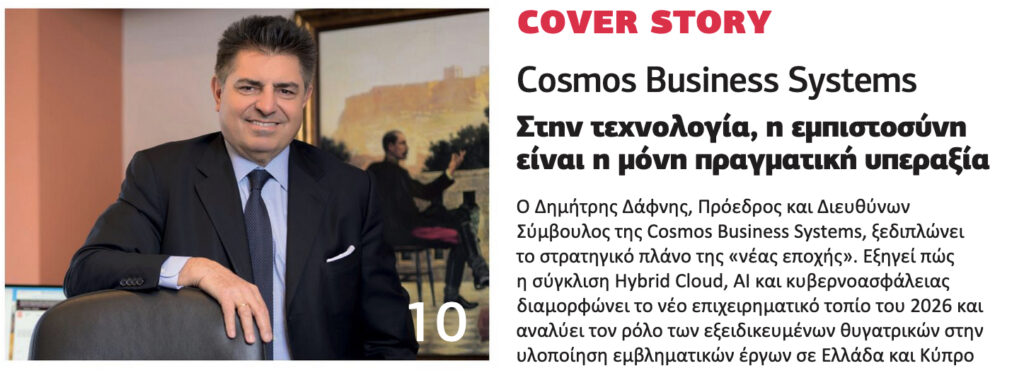
With a history spanning more than four decades, Cosmos Business Systems is not merely a historic pillar of the Greek IT market, but a dynamic organization that is constantly evolving.
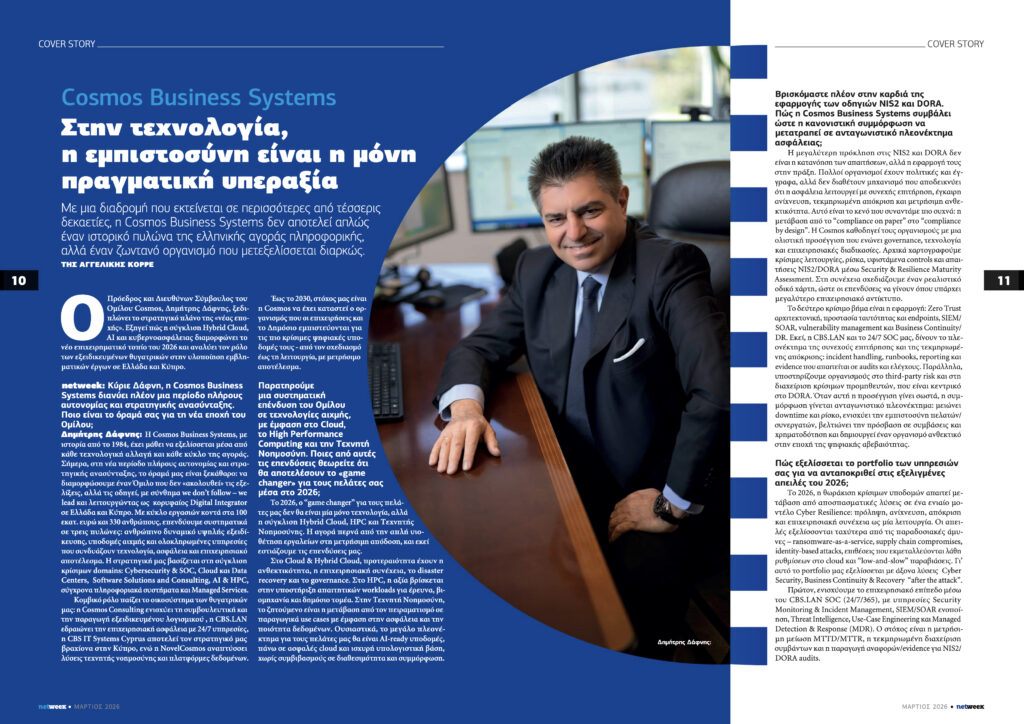
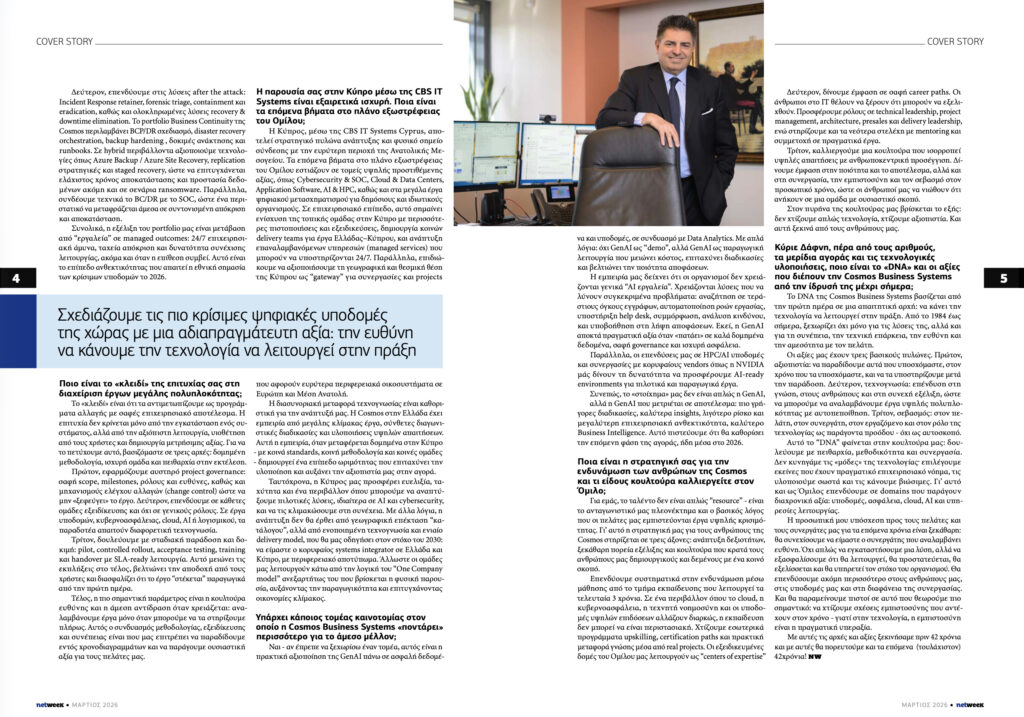
Dimitris Dafnis, Chairman and CEO of the Cosmos Group, outlines the strategic plan for the “new era.” He explains how the convergence of Hybrid Cloud, AI, and cybersecurity is shaping the new business landscape of 2026 and analyzes the role of specialized subsidiaries in the implementation of flagship projects in Greece and Cyprus.
Mr. Dafnis, Cosmos Business Systems is now entering a period of full autonomy and strategic realignment. What is your vision for the Group’s new era?
Cosmos Business Systems, with a history dating back to 1984, has learned to adapt to every technological change and every market cycle. Today, in this new era of full autonomy and strategic realignment, our vision is clear: to build a Group that does not merely “follow” developments, but leads them, under the motto “we don’t follow – we lead,” and operating as the leading Digital Integrator in Greece and Cyprus.
With a turnover of nearly €100 million and 330 employees, we systematically invest in three pillars: highly specialized human resources, cutting-edge infrastructure, and integrated services that combine technology, security, and business results. Our strategy is based on the convergence of critical domains: Cybersecurity & SOC, Cloud and Data Centers, Software Solutions and Consulting, AI & HPC, modern information systems, and Managed Services.
Our ecosystem of subsidiaries plays a pivotal role: Cosmos Consulting strengthens consulting and the development of specialized software, CBS.LAN solidifies operational security with 24/7 services, CBS IT Systems Cyprus serves as our strategic arm in Cyprus, while NovelCosmos develops artificial intelligence solutions and data platforms.
By 2030, our goal is for Cosmos to become the organization that businesses and the government trust for their most critical digital infrastructure—from design to operation, with measurable results.
We are seeing the Group make systematic investments in cutting-edge technologies, with a focus on the cloud, high-performance computing, and artificial intelligence. Which of these investments do you believe will be a “game changer” for your customers by 2026?
In 2026, the “game changer” for our customers will not be a single technology, but the convergence of Hybrid Cloud, HPC, and Artificial Intelligence. The market is shifting from simply adopting tools to achieving measurable performance, and that is where we are focusing our investments.
In Cloud & Hybrid Cloud, the priorities are resilience, business continuity, disaster recovery, and governance. In HPC, the value lies in supporting demanding workloads for research, industry, and the public sector. In Artificial Intelligence, the goal is to transition from experimentation to production use cases with an emphasis on security and data quality.
Essentially, the major advantage for our customers will be AI-ready infrastructure, built on a secure cloud and a robust computing foundation, without compromising on availability and compliance.
We are now in the midst of implementing the NIS2 and DORA directives. How does Cosmos Business Systems help turn regulatory compliance into a competitive security advantage?
The biggest challenge with NIS2 and DORA is not understanding the requirements, but putting them into practice. Many organizations have policies and documents, but lack a mechanism to demonstrate that security is working through continuous monitoring, early detection, documented response, and measurable resilience. This is the gap we encounter most frequently: the transition from “compliance on paper” to “compliance by design.”
Cosmos guides organizations with a holistic approach that integrates governance, technology, and business processes. First, we map critical functions, risks, existing controls, and NIS2/DORA requirements through a Security & Resilience Maturity Assessment. We then design a realistic roadmap so that investments are made where they have the greatest operational impact.
The second critical step is implementation: Zero Trust architecture, identity and endpoint protection, SIEM/SOAR, vulnerability management, and Business Continuity/DR. Here, CBS.LAN and our 24/7 SOC provide the advantage of continuous monitoring and documented response: incident handling, runbooks, reporting, and the evidence required for audits and inspections. At the same time, we support organizations with third-party risk and critical supplier management, which is central to DORA. When this approach is done correctly, compliance becomes a competitive advantage: it reduces downtime and risk, strengthens customer and partner trust, improves access to contracts and financing, and creates an organization that is resilient in an era of digital uncertainty.
How is your service portfolio evolving to address the sophisticated threats of 2026?
By 2026, securing critical infrastructure will require a shift from piecemeal solutions to a unified Cyber Resilience model: prevention, detection, response, and business continuity as a single function. Threats are evolving faster than traditional defenses—ransomware-as-a-service, supply chain compromises, identity-based attacks, attacks exploiting cloud configuration errors, and “low-and-slow” breaches. That is why our portfolio is evolving around “after the attack” solutions for Cyber Security, Business Continuity & Recovery.
First, we strengthen the operational level through the CBS.LAN SOC (24/7/365), with Security Monitoring & Incident Management services, SIEM/SOAR integration, Threat Intelligence, Use-Case Engineering, and Managed Detection & Response (MDR). The goal is a measurable reduction in MTTD/MTTR, documented incident management, and the generation of reports/evidence for NIS2/DORA audits.
Second, we invest in post-incident solutions: Incident Response retainers, forensic triage, containment, and eradication, as well as comprehensive recovery and downtime elimination solutions. Cosmos’ Business Continuity portfolio includes BCP/DR planning, disaster recovery orchestration, backup hardening, recovery testing, and runbooks. In hybrid environments, we leverage technologies such as Azure Backup / Azure Site Recovery, replication strategies, and staged recovery to achieve minimal recovery time and data protection even in ransomware scenarios. At the same time, we technically integrate BC/DR with the SOC so that an incident is immediately translated into a coordinated response and recovery.
Overall, the evolution of our portfolio is a shift from “tools” to managed outcomes: 24/7 operational defense, rapid response, and the ability to maintain operations, even when an attack occurs. This is the level of resilience required by the national significance of critical infrastructure in 2026.

What is the “key” to your success in managing highly complex projects?
The “key” is that we treat them as change initiatives with a clear business outcome. Success is not judged solely by the installation of a system, but by its reliable operation, user adoption, and the creation of measurable value. To achieve this, we rely on three principles: a structured methodology, a strong team, and discipline in execution.
First, we implement strict project governance: clear scope, milestones, roles, and responsibilities, as well as change control mechanisms to ensure the project stays on track.
Second, we invest in specialized vertical teams rather than generalist roles. In infrastructure, cybersecurity, cloud, AI, or software projects, deliverables require different expertise.
Third, we work with phased delivery and testing: pilot, controlled rollout, acceptance testing, training, and handover with SLA-ready operation. This reduces surprises at the end, improves user acceptance, and ensures that the project is productive from day one. Finally, the most important factor is a culture of accountability and immediate response when needed: we only take on projects when we can fully support them. It is this combination of methodology, expertise, and consistency that allows us to deliver on schedule and generate real value for our clients.
Your presence in Cyprus through CBS IT Systems is exceptionally strong. What are the next steps in the Group’s international expansion plan?
Through CBS IT Systems Cyprus, Cyprus serves as a strategic pillar of growth and a natural hub connecting the wider Eastern Mediterranean region. The next steps in the Group’s international expansion plan focus on high-value-added sectors such as Cybersecurity & SOC, Cloud & Data Centers, Application Software, AI & HPC, as well as large-scale digital transformation projects for public and private organizations.
At the operational level, this means strengthening the local team in Cyprus with more certifications and specializations, creating joint delivery teams for Greece–Cyprus projects, and developing managed services that can be supported 24/7. At the same time, we aim to leverage Cyprus’s geographical and institutional position as a “gateway” for collaborations and projects involving broader regional ecosystems in Europe and the Middle East.
The cross-border transfer of know-how is crucial to our growth. Cosmos in Greece has experience with large-scale projects, complex competitive processes, and high-demand implementations. When this experience is systematically transferred to Cyprus—with common standards, common methodology, and common teams—it creates a level of maturity that accelerates implementation and enhances our credibility in the market.
At the same time, Cyprus offers us flexibility, speed, and an environment where we can develop pilot solutions—particularly in AI and cybersecurity—and then scale them up. In other words, growth will not come from a “catalog” of geographic expansion, but from consolidated expertise and a unified delivery model, which will lead us to our 2030 goal: to be the leading systems integrator in Greece and Cyprus, with a regional footprint. After all, our teams operate under the “One Company model” regardless of their physical location, increasing productivity and achieving economies of scale.
Is there a particular area of innovation that Cosmos Business Systems is focusing on most for the immediate future?

Yes — if I had to single out one area, it would be the practical application of GenAI on secure data and infrastructure, combined with data analytics. Simply put: not GenAI as a “demo,” but GenAI as a productive operation that reduces costs, accelerates processes, and improves the quality of decisions.
Our experience shows that organizations generally do not need “AI tools.” They need solutions that solve specific problems: searching through massive volumes of documents, automating workflows, providing help desk support, ensuring compliance, conducting risk analysis, and aiding in decision-making. That’s where GenAI truly delivers value when it’s built on well-structured data, clear governance, and robust security.
At the same time, our investments in HPC/AI infrastructure and partnerships with leading vendors such as NVIDIA enable us to offer AI-ready environments for pilot and production projects.
Consequently, our “bet” is not simply on GenAI, but on GenAI that delivers tangible results: faster processes, better insights, lower risk, and greater operational resilience, as well as improved Business Intelligence. We believe this will define the next phase of the market, as early as 2026.
What is your strategy for empowering Cosmos employees, and what kind of culture are you fostering within the Group?
For us, talent isn’t just a “resource”—it’s our competitive advantage and the main reason our clients entrust us with high-stakes projects. That’s why our strategy for Cosmos’s people is based on three pillars: skill development, a clear career path, and a culture that keeps our people creative and united by a common purpose.
We systematically invest in empowerment through learning via our training department, which has been operating for the past three years. In an environment where the cloud, cybersecurity, artificial intelligence, and high-performance infrastructure are constantly changing, training cannot be an occasional activity. We build internal upskilling programs, certification paths, and practical knowledge transfer through real projects. Our Group’s specialized structures function as “centers of expertise.”
Second, we emphasize clear career paths. People in IT want to know they can grow. We offer roles in technical leadership, project management, architecture, presales, and delivery leadership, while also supporting junior staff through mentoring and participation in real projects.
Third, we foster a culture that balances high standards with a people-centric approach. We emphasize quality and results, but also collaboration, trust, and respect for personal time, so that our people feel they belong to a team with a meaningful purpose.
At the heart of our culture lies this principle: we don’t just build technology; we build trust. And that starts with our people.
Mr. Dafnis, beyond the numbers, market shares, and technological implementations, what is the “DNA” and what are the values that have guided Cosmos Business Systems from its founding to the present day?
From day one, Cosmos Business Systems’ DNA has been rooted in a demanding principle: making technology work in practice. From 1984 to the present, the company has distinguished itself not only for its solutions, but also for its consistency, technical expertise, accountability, and direct engagement with the customer.
Our values are built on three core pillars. First, reliability: delivering what we promise, when we promise it, and supporting it after delivery. Second, expertise: investing in knowledge, people, and continuous development so that we can take on highly complex projects with confidence. Third, respect: for the client, the partner, the employee, and the role of technology as a driver of progress—not as an end in itself.
This “DNA” is evident in our culture: we work with discipline, method, and collaboration. We don’t chase technology “trends”; we choose those that have real business value, implement them correctly, and make them sustainable. That is why, as a Group, we invest in areas that generate long-term value: infrastructure, security, cloud, AI, and operations services.
My personal commitment to our customers and partners for the coming years is clear: we will continue to be the partner who takes responsibility. Not just to install a solution, but to ensure that it works, is protected, evolves, and serves the organization’s purpose. We will invest even more in our people, our infrastructure, and the transparency of our collaboration. And we will remain true to what we believe is most important: building relationships of trust that stand the test of time—because in technology, trust is the real added value.
We set out 42 years ago guided by these principles and values,
and we will continue to be guided by them for at least the next 42 years!